How School ERP Software Simplifies Fee Management and Financial Operations
Published: April 6, 2026
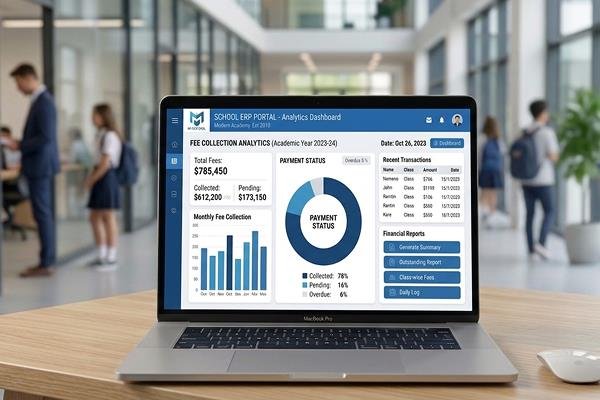
Efficient financial management is one of the most critical responsibilities of any educational institution.
Schools must handle multiple fee structures, track payments from hundreds or thousands of students,
manage financial records, and ensure transparency in every transaction. When these processes are managed
manually, they often become complex, time-consuming, and prone to errors.
This is where School ERP software plays an essential role. A modern ERP system helps educational institutions
automate fee management, streamline financial operations, and maintain accurate records.
Platforms like the M School ERP offered by ManageSchool provide schools with an integrated system that
simplifies the entire fee collection and financial management process.
The Challenges of Manual Fee Management
Traditional fee management systems rely heavily on manual record-keeping, spreadsheets, and paperwork. While these methods may work for smaller institutions, they become increasingly difficult to manage as schools grow.
Some common challenges include:
- Difficulty tracking paid and unpaid fees
- Time-consuming fee collection processes
- Errors in financial records and calculations
- Limited transparency in financial transactions
- Complex reconciliation of payments and reports
- Bulk invoicing challenges with automated discount calculations
Without a structured system, administrative staff spend a significant amount of time managing financial tasks instead of focusing on improving educational services.
Centralized Fee Management
A School ERP system provides a centralized platform where all fee-related information is organized and easily accessible. Administrators can configure various fee structures based on classes, courses, or academic programs.
With a centralized system, schools can manage:
- Tuition fees
- Transportation charges
- Examination fees
- Activity and event fees
This structured approach helps administrators maintain accurate records while making it easier to monitor fee payments and outstanding balances.
Flexible Fee Collection Methods
One of the major advantages of using School ERP software is the flexibility it offers in fee collection.
Schools can accept payments through multiple modes, including cash, bank transfer, cheque, or digital
payment options.
Additionally, Modern ERP systems support integration with major fee collection apps like Zenta,
Skiply, and leading payment gateways, enabling seamless and secure digital transactions.
This flexibility benefits both parents and school administrators. Parents can make payments conveniently,
while schools can process and record transactions quickly without manual data entry.
Automated Invoices and Receipts
Generating invoices and receipts manually can lead to delays and mistakes. School ERP software automates this
process by generating fee invoices and payment receipts instantly.
The system ensures that every transaction is recorded properly and that parents receive accurate documentation for their
payments. Automation also reduces administrative workload and improves the overall efficiency of financial operations.
Managing Discounts, Scholarships, and Concessions
Many schools offer scholarships, discounts, or special fee concessions to students. Managing these adjustments manually can be complicated,
especially when multiple approvals are required.
A School ERP system allows administrators to define concession policies and apply them to specific students when necessary.
This ensures transparency and consistency in how discounts and fee waivers are managed.
Real-Time Financial Monitoring and Reports
Financial reporting is an essential part of school administration. With ERP software, administrators can generate detailed financial reports in real time.
These reports may include:
- Student fee statements
- Outstanding payment reports
- Receipt summaries
- Fee collection reports
- Financial analysis and reconciliation
Such insights help school management monitor revenue flow, track pending payments, and make better financial decisions.
Integration with Accounting and Financial Systems
Another important advantage of School ERP software is its integration with accounting and
financial management systems. Every fee transaction can be automatically recorded within the
financial module, eliminating the need for duplicate data entry.
This integration ensures accuracy in accounting records and simplifies tasks such as budgeting,
expense tracking, and financial reconciliation.
Improving Transparency and Administrative Efficiency
By digitizing financial processes, schools can significantly improve transparency and operational efficiency.
Administrators can track every transaction, monitor payment status, and generate reports with just a few clicks.
This reduces the risk of financial errors and enables staff to focus on more strategic activities that contribute to the institution’s growth.
Conclusion
School ERP software has become an essential tool for modern educational institutions. By automating fee collection, simplifying financial management, and providing real-time insights, ERP systems help schools operate more efficiently and transparently.
